

25 August 2010
Omar be coming
A word cloud analysis of a Facebook poll, generating more than 2,000 responses, reveals a clear winner of users' favorite member of “The Street” in The Wire. It also highlights how useful word clouds can be to quickly interpret (and illustrate) a large amount of data.


09 August 2010
How Sexualisation Entered the Public Lexicon
In today's Guardian Laurie Penny of the 'Penny Red' blog states: "The word [sexualisation] wheedled its way into the language of women's liberation like a semiotic sleeper agent. It was seen in headlines as early as 2007, but after the Home Office report on the sexualisation of young people last February, it was suddenly everywhere, with David Cameron wooing middle-England voters on a platform of "stopping the sexualisation of children", and Mumsnet launching their Let Girls Be Girls campaign against the "sexualisation" of children by clothes retailers."
I've tracked all mentions of the use of the word 'sexualisation' during the last 18 months across mainstream and social media coverage. As a result, this analysis focuses on Anglo-reporting (UK, Australia and Canada) of the word as it excludes the Americanised 'sexualization'.
The analysis reveals a strong correlation (0.78) between mainstream reporting and subsequent mentions by the public on social networking sites.
In addition the findings suggest that once a phrase, word or meme is used in mainstream news reports they quickly become a part of the public's lexicon.
Early peaks in mainstream coverage were driven by a boy who became a father at the age of 13, with subsequent regional media reports discussing the 'sexualisation of children' in the UK (February 2009 - 38 articles); an Australian senate hearing into the 'sexualisation of media' (August 2009 - 16 articles); Pru Goward's comments in Australia and a Brooke Shields photograph (both October 2009 - 17 articles).
However, it was the widespread reporting of Linda Popadopoulus's report on the "sexualisation of children" in February 2010 (102 articles) that really pushed the word into the wider public consciousness (1,025 social media posts). This resulted in the Mumsnet protest against the "sexualisation of prepubscent girls" which prompted the withdrawal of a child's padded bra from Primark (816 social media posts in April 2010).
By May 2010 (55 articles), a number of different stories (including M&S bra tops, the Amy King campaign group on Facebook and coalition promises), reported by various mainstream media outlets, were using the word to report younger girls becoming aware of sexuality too young.
Google Insights for Search reveals a sharp rise in 'sexualisation' in March 2010 as the public searched for Popadopoulus's report. However, searches quickly fell away the following month reflecting a drop in interest. The fact the word remains in frequent use on social media sites suggests it has now become etched into everyday language.


I've tracked all mentions of the use of the word 'sexualisation' during the last 18 months across mainstream and social media coverage. As a result, this analysis focuses on Anglo-reporting (UK, Australia and Canada) of the word as it excludes the Americanised 'sexualization'.
The analysis reveals a strong correlation (0.78) between mainstream reporting and subsequent mentions by the public on social networking sites.
In addition the findings suggest that once a phrase, word or meme is used in mainstream news reports they quickly become a part of the public's lexicon.
Early peaks in mainstream coverage were driven by a boy who became a father at the age of 13, with subsequent regional media reports discussing the 'sexualisation of children' in the UK (February 2009 - 38 articles); an Australian senate hearing into the 'sexualisation of media' (August 2009 - 16 articles); Pru Goward's comments in Australia and a Brooke Shields photograph (both October 2009 - 17 articles).
However, it was the widespread reporting of Linda Popadopoulus's report on the "sexualisation of children" in February 2010 (102 articles) that really pushed the word into the wider public consciousness (1,025 social media posts). This resulted in the Mumsnet protest against the "sexualisation of prepubscent girls" which prompted the withdrawal of a child's padded bra from Primark (816 social media posts in April 2010).
By May 2010 (55 articles), a number of different stories (including M&S bra tops, the Amy King campaign group on Facebook and coalition promises), reported by various mainstream media outlets, were using the word to report younger girls becoming aware of sexuality too young.
Google Insights for Search reveals a sharp rise in 'sexualisation' in March 2010 as the public searched for Popadopoulus's report. However, searches quickly fell away the following month reflecting a drop in interest. The fact the word remains in frequent use on social media sites suggests it has now become etched into everyday language.


14 July 2010
Lindsay and LeBron dominate news searches
According to Pew Research Center's latest weekly News Interest Index, interest in the Gulf oil leak has started to see a fall in the percentage of the public following the story closely.

An analysis of news searches across the last four months reveals a very similar pattern:
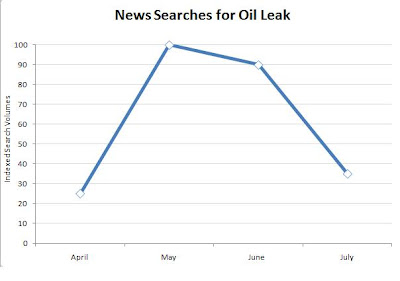
However, Pew's findings for the most popular news items reveals a marked difference to the most searched for stories.

In relation to its sampling methods, Pew states that "in addition to sampling error, one should bear in mind that question wording and practical difficulties in conducting surveys can introduce error or bias into the findings of opinion polls".
However, a quick look at the most searched for news stories, suggests respondents may in fact be attempting to appear somewhat more highbrow when speaking to Pew researchers.

In contrast to the oil leak and the immigration law debate, LeBron James move to the Miami Heat and Lindsay Lohan's 90-day jail sentence dominate online news interest.
According to Pew, large majorities actually said that news organizations gave too much coverage last week to Lohan’s legal woes (71%) and James’s announcement (61%).
With interest in Spain winning the World Cup third in online news searches, it seems that America is not quite ready to admit to an interest in either soccer or celebrity.

An analysis of news searches across the last four months reveals a very similar pattern:

However, Pew's findings for the most popular news items reveals a marked difference to the most searched for stories.

In relation to its sampling methods, Pew states that "in addition to sampling error, one should bear in mind that question wording and practical difficulties in conducting surveys can introduce error or bias into the findings of opinion polls".
However, a quick look at the most searched for news stories, suggests respondents may in fact be attempting to appear somewhat more highbrow when speaking to Pew researchers.

In contrast to the oil leak and the immigration law debate, LeBron James move to the Miami Heat and Lindsay Lohan's 90-day jail sentence dominate online news interest.
According to Pew, large majorities actually said that news organizations gave too much coverage last week to Lohan’s legal woes (71%) and James’s announcement (61%).
With interest in Spain winning the World Cup third in online news searches, it seems that America is not quite ready to admit to an interest in either soccer or celebrity.
12 July 2010
Adidas gains search boost from World Cup sponsorship
According to research from NM Incite, a Nielsen and McKinsey joint venture showed, in the build-up to the World Cup Nike claimed 30.2% of World Cup-related online buzz, twice as much as its rival and official sponsor, Adidas.
However, an analysis of the share of global search behaviour since 2004 reveals that of Adidas's top 10 most successful weeks, five occured during the 2006 World Cup in Germany and five were during this year's tournament in South Africa.
On average, Adidas saw a 6 percentage point weekly lift during the two World Cups suggesting that the sponsorship deal was paying dividends.


However, an analysis of the share of global search behaviour since 2004 reveals that of Adidas's top 10 most successful weeks, five occured during the 2006 World Cup in Germany and five were during this year's tournament in South Africa.
On average, Adidas saw a 6 percentage point weekly lift during the two World Cups suggesting that the sponsorship deal was paying dividends.


08 July 2010
Video Game Searches Match Sales
According to industry tracker NPD, sales of video game software and equipment in the United States fell 5 percent in May.
An analysis of product searches within the Video & Games category on Google Insights for Search also reveals a corresponding 5 percent decline in May.
In contrast product searches rose in May 2008 and stayed fairly flat in May 2009, suggesting this is not a seasonal trend.
Red Dead Redemption, the top game in May 2010 with 1.5 million units sold, was also the fastest rising search - up 1,150% month-on-month.
Nintendo Co Ltd's Wii was the top-selling home console in May, followed by Microsoft's Xbox 360 and Sony's PlayStation 3. Within product searches however, the Xbox was marginally ahead of the Wii, with the PS3 third.

An analysis of product searches within the Video & Games category on Google Insights for Search also reveals a corresponding 5 percent decline in May.
In contrast product searches rose in May 2008 and stayed fairly flat in May 2009, suggesting this is not a seasonal trend.
Red Dead Redemption, the top game in May 2010 with 1.5 million units sold, was also the fastest rising search - up 1,150% month-on-month.
Nintendo Co Ltd's Wii was the top-selling home console in May, followed by Microsoft's Xbox 360 and Sony's PlayStation 3. Within product searches however, the Xbox was marginally ahead of the Wii, with the PS3 third.

28 June 2010
Brand Rooney suffers
According to Opta's statistics Wayne Rooney has lost the ball by being tackled in possession more often than any other player at this year's World Cup.
A comparison of his performance in the opening match against USA and final game with Germany reveals a quite dramatic deterioration in his passing accuracy too.

The bad news for brand Rooney is that, not only are there more eyes on him than ever before, global interest is also higher than it has been since his disappointing World Cup in 2006.

A comparison of his performance in the opening match against USA and final game with Germany reveals a quite dramatic deterioration in his passing accuracy too.

The bad news for brand Rooney is that, not only are there more eyes on him than ever before, global interest is also higher than it has been since his disappointing World Cup in 2006.

24 June 2010
Predicting Big Brother Using Search
There have been a number of blog posts about using social media buzz to predict the results of reality TV shows, but what about search?
Looking at the final series of Big Brother in the UK, we can see two names dominating searches - Rachel (actually spelled Rachael) and John James.
Participants about whom the public feel fairly neutral are unlikely to attract much interest so we can probably say with some confidence these two are either very popular or very unpopular.
Whilst interest in the former resulted in her being the first to be evicted from the house, the widespread activity around the latter suggest the smart money would be on him to win.

Looking at the final series of Big Brother in the UK, we can see two names dominating searches - Rachel (actually spelled Rachael) and John James.
Participants about whom the public feel fairly neutral are unlikely to attract much interest so we can probably say with some confidence these two are either very popular or very unpopular.
Whilst interest in the former resulted in her being the first to be evicted from the house, the widespread activity around the latter suggest the smart money would be on him to win.

Search and Twitter closely entwined
You can have data without information, but you cannot have information without data. Sometimes, however, the data speaks for itself...


23 June 2010
USA success over Algeria leads to search mania
With the first nine searches on Google Hot Trends (possibly 10 if the final search is Americans looking for World Cup tickets), this confirms the fact the USA is definitely very interested in soccer right now...

It would appear that the fear of supporting an unsuccessful team was all that was holding back the US.

It would appear that the fear of supporting an unsuccessful team was all that was holding back the US.
22 June 2010
Predicting Cigar Sales Using Search
"If you can predict the future better than other people, you will soon become rich. If you can know better than other people what is happening right now, that is almost as good. After all, if no one else finds out the truth until a month after the fact, the present might as well be the future — nobody knows it." Steven D. Levitt (Author of Freakonomics)
Habanos SA, a joint venture between Cuba and Imperial Tobacco Group, registered an 8% fall in overseas sales of Cuban cigars in 2009. Consultants Bain also report an 8% decline in sales in the UK, France, Germany and Switzerland.
Highlighting the effectiveness of using search volumes as a tool for predicting the present, global searches also fell 8% in 2009.
Using Google Insights for Search forecasting tool we can predict that Cuban cigar sales will fall a further 7% in 2010.

Habanos SA, a joint venture between Cuba and Imperial Tobacco Group, registered an 8% fall in overseas sales of Cuban cigars in 2009. Consultants Bain also report an 8% decline in sales in the UK, France, Germany and Switzerland.
Highlighting the effectiveness of using search volumes as a tool for predicting the present, global searches also fell 8% in 2009.
Using Google Insights for Search forecasting tool we can predict that Cuban cigar sales will fall a further 7% in 2010.

водки поиски продолжают рост
("Vodka searches keep on rising")
The Guardian today reports that using "sensationalist adverts, steep price rises and bombastic rhetoric, Russia is pulling out all the stops to curb the national love affair with vodka that is estimated to cause 500,000 deaths a year, especially among men", adding: "A series of haunting ads broadcast round the clock on state-run television show in graphic detail the damage that the drink can do. Viewers follow a gulp of the spirit down a man's throat – vodka is blamed particularly for premature deaths among men – from where it travels to his heart, lungs, brain and liver, causing explosions akin to bomb blasts."
Unfortunately for President Dmitry Medvedev searches for 'водка' (vodka in Russian) have climbed steeply each year, with 'vodka price' (водка цена) the main driver of searches. Moscow, St Petersburg, Novosibirsk and Yekaterinburg lead the way in search volumes.
Mikhail Gorbachev's anti-alcohol campaign was reported to have contributed to a rise in his unpopularity. With the presidential election just one year away, a similar effect on Medvedev's ratings could be just the tonic Vladimir Putin needs for his much-anticipated return to power.

The Guardian today reports that using "sensationalist adverts, steep price rises and bombastic rhetoric, Russia is pulling out all the stops to curb the national love affair with vodka that is estimated to cause 500,000 deaths a year, especially among men", adding: "A series of haunting ads broadcast round the clock on state-run television show in graphic detail the damage that the drink can do. Viewers follow a gulp of the spirit down a man's throat – vodka is blamed particularly for premature deaths among men – from where it travels to his heart, lungs, brain and liver, causing explosions akin to bomb blasts."
Unfortunately for President Dmitry Medvedev searches for 'водка' (vodka in Russian) have climbed steeply each year, with 'vodka price' (водка цена) the main driver of searches. Moscow, St Petersburg, Novosibirsk and Yekaterinburg lead the way in search volumes.
Mikhail Gorbachev's anti-alcohol campaign was reported to have contributed to a rise in his unpopularity. With the presidential election just one year away, a similar effect on Medvedev's ratings could be just the tonic Vladimir Putin needs for his much-anticipated return to power.

19 June 2010
America doesn't care about soccer?

Maybe they didn't, but they do now.
If even the Cameroon v Denmark match is registering as the fourth hottest search in the US, and is trending highly on Twitter (62% US-based users), perhaps we can finally put an end to this oft-repeated claim?
Of course not everyone is interested, but that's why ESPN is trying to make you watch.
17 June 2010
William Hill promos drive World Cup searches
Amongst the high street bookmakers, William Hill appears to be one of the biggest beneficiaries of the World Cup so far with UK searches up 38% in the last week.
Normally closely tracking rival Ladbrokes throughout the last year, William Hill has pulled away in the last seven days June thanks to a series of 'free bets' promoted in the mainstream press.
Ladbrokes is up just 22% in comparison.
Paddy Power, however, has seen searches surge 88% week-on-week - although from a much lower starting level. In contrast, Coral has barely registered any increase in interest.

Normally closely tracking rival Ladbrokes throughout the last year, William Hill has pulled away in the last seven days June thanks to a series of 'free bets' promoted in the mainstream press.
Ladbrokes is up just 22% in comparison.
Paddy Power, however, has seen searches surge 88% week-on-week - although from a much lower starting level. In contrast, Coral has barely registered any increase in interest.

More misery for Rob Green and ITV
The most searched for news items in the UK over the last seven days sees Robert Green and the England v USA game top the table - both up more than 5,000% on the previous week, according to Google Insights for Search.
The start of the World Cup dominated news searches, accounting for six of the top ten.
A series of negative headlines surrounding ITV's failure to broadcast the first England goal of 2010 tournament and sacking of Robbie Earle ("Will ITV deliver another World Cup cock-up?" - The Daily Mirror, 17th June) sees it place third with searches up 600% week-on-week.
Away from the World Cup, the launch of the iPhone 4, the Xbox 360 motion sensor and the final Big Brother series were all to the fore of public consciousness.

The start of the World Cup dominated news searches, accounting for six of the top ten.
A series of negative headlines surrounding ITV's failure to broadcast the first England goal of 2010 tournament and sacking of Robbie Earle ("Will ITV deliver another World Cup cock-up?" - The Daily Mirror, 17th June) sees it place third with searches up 600% week-on-week.
Away from the World Cup, the launch of the iPhone 4, the Xbox 360 motion sensor and the final Big Brother series were all to the fore of public consciousness.

15 June 2010
FTSE set to rebound?
“It is not a case of choosing those [faces] that, to the best of one’s judgment, are really the prettiest, nor even those that average opinion genuinely thinks the prettiest. We have reached the third degree where we devote our intelligences to anticipating what average opinion expects the average opinion to be. And there are some, I believe, who practice the fourth, fifth and higher degrees.” (John Maynard Keynes, General Theory of Employment Interest and Money, 1936).
By Keynes logic, people price shares not based on what they think their fundamental value is, but rather on what they think everyone else thinks their value is.
With more than half of all Internet users beginning any session with a Google search and 76% of the UK online, Google Insights for Search arguably provides us with an opportunity to gage the behavourial habits of 20 million members of the British public.
Can we use Google Trends to see if the average person thinks the FTSE has reached a low? With the FTSE 100 down 3.6% across the last 12 months and 6.7% in the last three months, the resulting surge in searches for 'buy shares' in the UK in the last week suggest now may be as good a time as any to buy in.

By Keynes logic, people price shares not based on what they think their fundamental value is, but rather on what they think everyone else thinks their value is.
With more than half of all Internet users beginning any session with a Google search and 76% of the UK online, Google Insights for Search arguably provides us with an opportunity to gage the behavourial habits of 20 million members of the British public.
Can we use Google Trends to see if the average person thinks the FTSE has reached a low? With the FTSE 100 down 3.6% across the last 12 months and 6.7% in the last three months, the resulting surge in searches for 'buy shares' in the UK in the last week suggest now may be as good a time as any to buy in.

09 June 2010
Less interest in 2010 World Cup for England fans

Not surprisingly interest in the World Cup within host nation South Africa has soared, with search volumes for May 2010 up almost 500% on the same period in 2006.
However, the UK has seen an 18% dip in interest; perhaps a reflection of reduced expectations amongst England fans. As former captain Terry Butcher recently commmented: "This time, there seems to be a little less hype about England, and expectations seem a little more realistic. Perhaps in 2002 and 2006 it was a bit over the top and it got to the players."
Having qualified for the first time in 32 years last time round, it is actually more of a surprise that Australian search volumes haven't dipped more.
Finally, US expectations of qualifying for the second round are high ("American fans are thinking we should advance out of the group, and I like that. I like how they’re thinking. We feel confident as well that this is a group we can get out of,” said captain Carlos Bocanegra after the draw) and this is reflected in the 42% increase in searches on 2006.
08 June 2010
Lost finale creates opening for Catholicism
The recent Lost finale contained the revelation that the "flash sideways" universe was actually purgatory.
As a result, searches for 'purgatory' (normally at a fairly consistent level) were up to almost five times normal levels (with buzz on blogs also up 700%).
Searches for the definition of the term were also up 160%, with the US, Canada and the UK the most curious.
Occupying the second and third positions on a Google search for purgatory, the Catholic Church may be amongst the more unusual beneficiaries of the Lost phenomenon.


As a result, searches for 'purgatory' (normally at a fairly consistent level) were up to almost five times normal levels (with buzz on blogs also up 700%).
Searches for the definition of the term were also up 160%, with the US, Canada and the UK the most curious.
Occupying the second and third positions on a Google search for purgatory, the Catholic Church may be amongst the more unusual beneficiaries of the Lost phenomenon.


06 June 2010
James Avery and Twitter
James Avery ('Uncle Phil' from the Fresh Prince of Bel Air) is presently the fastest rising search on Google and ranks number seven on Twitter trends.
A false rumour he had died was widely re-tweeted and spread quickly amongst users.
Perhaps one of the most interesting aspects of this is the speed at which this meme transferred so quickly from Twitter to searches on Google.
Whilst the micro-media site is still comparatively niche with regard to active users, 50% of the public start any Internet session with a Google search.
This arguably demonstrates the fact that while Twitter is clearly widely 'read', social media is still not a trusted source of information for good reason.

A false rumour he had died was widely re-tweeted and spread quickly amongst users.
Perhaps one of the most interesting aspects of this is the speed at which this meme transferred so quickly from Twitter to searches on Google.
Whilst the micro-media site is still comparatively niche with regard to active users, 50% of the public start any Internet session with a Google search.
This arguably demonstrates the fact that while Twitter is clearly widely 'read', social media is still not a trusted source of information for good reason.

19 May 2010
Liberal Democrat Coalition Backlash?
Prominent left-wing blog Liberal Conspiracy recently called for "left-liberals to join Labour" and Alastair Campbell also tweeted that it was "good to see Lib Dem defections to Labour still going - keep 'em coming".
Does Google confirm this trend? For the first time, in the week to 15th May, searches for 'join Labour' has generated enough volumes to begin trending in the UK. As a comparison, I've run it against 'join Facebook' and fascinatingly more people have been searching for 'join Labour' this past week.

Does Google confirm this trend? For the first time, in the week to 15th May, searches for 'join Labour' has generated enough volumes to begin trending in the UK. As a comparison, I've run it against 'join Facebook' and fascinatingly more people have been searching for 'join Labour' this past week.

Is the worst of the Facebook privacy backlash over?

Although this chart suggests that the peak for people searching for how to delete their Facebook profile has passed, in reality searches for the site always dip on Sundays and Mondays (after peaking on Fridays and Saturdays) so we'll need to wait until next weekend to see if the climb down has had any effect.
Meanwhile, unless people are using radically different search terms on the two sides of the Atlantic (and even looking at 'join Facebook' illustrates the same pattern), a comparison of people searching for 'Facebook sign up' against 'delete Facebook' suggests the problem is much bigger in the US than the UK.


Subscribe to:
Posts (Atom)
