19 May 2010

Liberal Democrat Coalition Backlash?

Prominent left-wing blog Liberal Conspiracy recently called for "left-liberals to join Labour" and Alastair Campbell also tweeted that it was "good to see Lib Dem defections to Labour still going - keep 'em coming".

Does Google confirm this trend? For the first time, in the week to 15th May, searches for 'join Labour' has generated enough volumes to begin trending in the UK. As a comparison, I've run it against 'join Facebook' and fascinatingly more people have been searching for 'join Labour' this past week.

Is the worst of the Facebook privacy backlash over?


Although this chart suggests that the peak for people searching for how to delete their Facebook profile has passed, in reality searches for the site always dip on Sundays and Mondays (after peaking on Fridays and Saturdays) so we'll need to wait until next weekend to see if the climb down has had any effect.

Meanwhile, unless people are using radically different search terms on the two sides of the Atlantic (and even looking at 'join Facebook' illustrates the same pattern), a comparison of people searching for 'Facebook sign up' against 'delete Facebook' suggests the problem is much bigger in the US than the UK.


16 May 2010

The beginning of the end for Facebook?

Concerns over privacy issues have engulfued Facebook in recent weeks and the widespread media coverage has seen searches for the site in May fall for the first time in its history.

The past week has also seen a dramatic surge in people searching for 'delete facebook' (courtesy of Google Insights for Search). Unlike MySpace and, even email sites such as Hotmail and Gmail, for whom delete searches have remained relatively stable once they first start trending, Facebook has seen a sharp increase in searches for 'delete facebook' since the end of 2008.


Confirming this is a global problem, searches for 'effacer facebook', 'löschen facebook' and 'cancellare facebook' have all followed a very similar pattern (although the latter actually peaked in February) on Google Trends.

Meanwhile, underlining its rising popularity, 'delete twitter' is barely registering in comparison (although it did begin trending in the US in April 2009 and, like MySpace, has remained stable - albeit at much lower volumes since).

06 May 2010

Twitter Exit Poll - 10pm


With a final total of 1,052 tweets at 10pm I'm going against the exit polls indicating a hung parliament and calling it for the Conservatives with a majority of 74 seats!


This social media analysis of the 2010 election was based on a (quick and rather unscientific) analysis of tweets stating for "just voted" in connection with all the parties or their respective leaders.

Election 2010: Social Media Analysis - 8:45PM update


Following on from my earlier post and with the sample size up to a marginally more representative 823 posts, the Conservative lead has been cut back to 100 seats - largely due to gains from other parties (including the most recent tweets from XROBOX - "Just voted, SNP. McGovern out you scumbag, Would also prefer a torrie majority than labour staying in power"; CHMP4Z - "has just voted UKIP"; and DAMBNRY - "Just voted. Was a toss up between Labour and Green but I went with Green.").

Labour are still languishing in third with regard to percentage share (22.8%) but would be up 11 seats to 180.

Nick Clegg: Word Cloud Analysis

The Daily Mail has recently accused Nick Clegg of disguising his past views - does an analysis of the words used most commonly in his major speeches from 2007 to date indicate any shift in emphasis?

After winning the two-month contest to succeed Sir Menzies Campbell in September, his appetite for change and ambition to lead the party to greater heights is apparent...


While his first conference speech as party leader in September 2008 illustrates how focused he was on the Labour government, rather than his own party's policies...


His speech to the Autumn conference in September 2009 sees a shift back to change and more focus on the Conservatives than Labour...


However, launching the manifesto in April 2010, Clegg is much more interested in his own party and establishing a fairer Britain. The theme of change appears to have been dropped in order to differentiate himself from Cameron and the City is for the first time a focus of attack.


While the TV debates clearly buoyed support for the party, this word cloud analysis also highlights how focusing on his own party's policies (rather than Labour or the Conservatives) has helped the Liberal Democrats to carve out a larger share of support through clearer messages that resonate with the public.

Facebook Fans: Clegg v Cameron


As previously reported here first, it wasn't until as late as 18th April that Nick Clegg first accumulated more fans on Facebook. However, in the three weeks to election day he has soared ahead of Cameron to claim at least one victory on May 6th.

Election 2010: Social Media Analysis


Using the admittedly rather unscientific research technique of analysing tweets for "just voted" in connection with all the parties or their respective leaders signals, as of 6pm, the Conservatives would be heading for a majority of 140 seats.

Considering the supposed left-wing bias of Twitter this makes for interesting reading or is perhaps a reflection of the fact right-wing voters are more likely to vote before work...

Here is how the electoral map of the UK would look:

17 April 2010

Clegg mania continues

UPDATE: As of 21:33 on 18 April, Clegg now has more fans than Cameron on Facebook, having gained more than 10,000 since Thursday night


Confirming the difference a televised debate can make, the surge in media coverage around Nick Clegg has also resulted in a dramatic rise in online searches for the Liberal Democrat leader. Mentions of Clegg have also risen almost exponentially across all social media, driven largely by Twitter.


Almost twice as many users are now following Clegg on Twitter as a result, making him the most followed British politician on the micro-media site.


At the time of writing, Clegg has also seen his fanbase on Facebook rise by more than 10,000 to 23,458 - marginally behind David Cameron on 25,478.

Surpassing the volume of searches when Clegg was elected leader of the party in December 2007 for the first time, visits to the party's website are also up 170% on last month and more than double any point in the past two years.


Underlining the fact that Clegg must differentiate himself from Cameron in the eyes of voters, almost 50% more voters subsequently searched for Cameron than Gordon Brown and 5.6% of visitors to the Lib Dem website came from Conservatives.com, as opposed to 3.6% from Labour.org.uk.

The ITV debate also saw Clegg overtake his two rivals in search volumes for the first time since Brown called the election on April 6th and move further ahead the following day. Although this may be largely down to the fact that many viewers had never heard of him, the increased traffic to the party website suggests voters may now be more open to switching allegiances after the debate than prior to it.


'Nick Clegg wiki' was also a prominent search, highlighting the fact that many voters are looking to find out more about his background - attacking his record as a career politician may be next line of assault for the Tories and Labour.

Meanwhile, searches for Clegg's wife was the biggest rising search term - perhaps the most depressing reality of the 2010 election.

14 April 2010

Fleet's Street influence on the 2005 Election


Continuing on from the previous post analysing the media's influence on the election across the last 65 years, I've created a visualisation of newspaper support for the three main political parties at the 2005 election (the size of the bubble corresponds to circulation).

As previously noted, despite Lord Mandelson's protestations to the contrary, The Sun's defection to the Tories looks set to have a significant effect on the outcome (even if it is just conformation the tide of public opinion has turned against New Labour - rather than its own influence on voters) and we could conceivably see press support shape up like this in 2010:

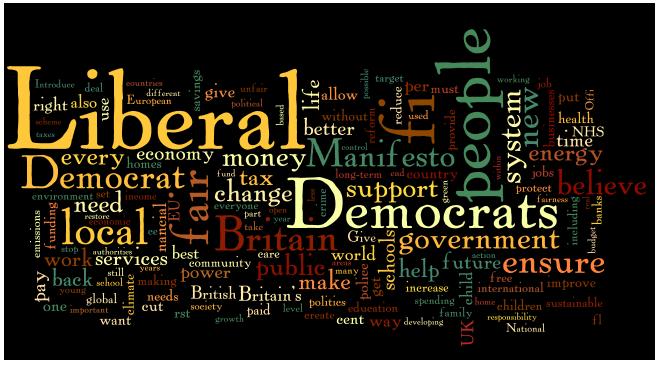
Liberal Democrat Manifesto: Word Cloud Analysis


The Liberal Democrats have now launched their election manifesto. In the absence of a Wordle cloud analysis on today's Guardian Data Blog here is the result.

Besides the obvious theme of a fairer society, there is interestingly a noticeable absence of opposition mentions.

The Guardian's original comparison of Labour and the Tories can be found here.

Believe the e-hype: this is a Net election

Although quite correct in highlighting the fact that its role as a game changer has been over-hyped, Roy Greenslade’s withering assessment of the role of social media in this year’s election is wrong in its assertion that it has no influence.

Like many commentators he provides a straight comparison between mainstream and social media, mistaking direct reach as the sole barometer of influence (a quick tally of Sarah Brown’s followers on Twitter and the circulation of the Evening Standard provides an obvious illustration of how even this measure doesn’t always work in the favour of many newspapers).

Social media is not a direct challenge to mainstream media and perhaps part of the problem lies in the name. Social media is primarily a means of communication – it makes as much, if not more, sense to compare a tweet to a letter as a newspaper.

The reason it is influential in this election is the fact it has reduced the role of two gatekeepers – mainstream media and polling companies. Not only can politicians easily communicate more directly with the electorate but, perhaps more importantly, the electorate can easily communicate more directly with them.

Greenslade claims the mainstream media sets the agenda but then goes on to state that “David Cameron believes in internet power because he has shown enormous enthusiasm for the web [and] put considerable effort into [his] YouTube offerings”. However many people view the video, is this not a sign that the Internet has influenced the agenda for no less than the next possible Prime Minister?

The media’s role as a gatekeeper has changed too. Whereas once an editor picked a handful of letters to illustrate public reaction, now people can comment directly on a story on a newspaper’s site. This may highlight the fact that, in most cases, mainstream media is still setting the agenda but the comments below the article also represent social media in action.

All those comments, tweets and blogs also provide a wealth of data to analyse too.

No longer is YouGov or ComRes in sole control of determining the views of the public based on a questionnaire of 1,000 people. As the recent ‘Ask the Chancellors’ on Channel 4 illustrated, tools like Twitter offer the public an instant way in which to offer their opinion and anyone can harness all the data that subsequently becomes available.

Social media won’t change the result of this election but it has already changed the way in which we communicate with politicians. Perhaps more significantly though, it has fundamentally changed the way in which we gauge public opinion.

13 April 2010

The Most Dangerous Football Grounds in the Country

Piling on the misery for the clubs most likely to be relegated from the Football League, Darlington and Grimsby Town are revealed to be the two most dangerous clubs to visit in the country.

Using statistics on football-related arrests and banning orders from the Home Office and factoring in average attendance figures, Darlington has the most troublesome fans in England. Despite an average crowd of less than 2,000, Darlington has 28 banning orders against risk supporters.

Not surprisingly Millwall, Cardiff City and Leeds United all feature in the bottom 15, with FA Cup finalists Portsmouth the worst Premier League offenders in 13th place. As of 30th October 2008 Leeds had the most fans with banning orders (152), ahead of Cardiff (136) and Millwall (117).

1 Darlington
2 Grimsby Town
3 Millwall
4 Chesterfield
5 Tranmere Rovers
6 Lincoln City
7 Cardiff City
8 Leeds United
9 Scunthorpe United
10 Hartlepool United
11 Shrewsbury Town
12 Port Vale
13 Portsmouth
14 Plymouth Argyle
15 Coventry City

The safest grounds in the country sees Accrington Stanley and Milton Keynes Dons top the list, with Fulham's Craven Cottage the safest Premier League ground for travelling fans in fifth. Arsenal are the only other Premiership club to feature in the top 15 in 12th place.

=1 Accrington Stanley
=1 Milton Keynes Dons
3 Gillingham
4 Wycombe Wanderers
5 Fulham
6 Yeovil Town
7 Norwich City
8 Dagenham & Redbridge
9 Brentford
10 Macclesfield Town
11 Reading
12 Arsenal
13 Cheltenham Town
14 Northampton Town
15 Ipswich Town

12 April 2010

What do Guardian readers think of US foreign policy?


An analysis of more than 300 Guardian readers' comments on US foreign policy, reveals that the issue of the Iraq war is almost twice as prominent as Afghanistan, despite the escalating violence in the latter.

JackCoyle76 said that he believes Iraq is "on the brink of civil war and violence escalating exponentially", whilst jigen stated that "Iraq is a mess because it was important to the cloudy-eyed business leaders of today; they seek profits not stability".

'WMD', 'Oil' and 'interests' were all to the fore, with Bush appearing three times as frequently Obama. Hoof1 typified the anger of many in posting: "Bush's administration, led by Cheyney, saw an opportunity to exploit security concerns to bolster 'US strategic interests' (oil) in the middle east by creating a client state in Iraq. The fact that Haliburton could make millions from controlling the basic infrastructure of Iraq post the invasion was a nice bonus for Cheyney."

11 April 2010

Political Party Blogs - Word Cloud Analysis

Running feeds of the three major political blogs through through Wordle (a word-cloud generating tool), omitting nongermane words, provides an interesting perspective into their current media strategies.

Here is Conservative Home:


Labour List:


Finally, Lib Dem Voice:


This does appear to suggest Labour is more focused on the opposition, instead of its own policies, with 'Tories' very prominent. Interestingly, Osborne appears to be more of a focal point of posts than Cameron - suggesting the party does perceive him to the be the weakest link to target.

Conservative Home, whilst more focused on Cameron and its own party, on the surface does appear to be lighter on policy specifics than the other two blogs.

Whilst Lib Dem Voice appear to be the most policy driven blog, the Labour government does feature prominently. This contrasts to most of Cable's recent press appearances, in which the Conservatives have been the focal point of attack, including the most recent poster (which Cable was heavily taken to task over by Jon Sopel on The Politics Show this morning).


In addition, the fact that no words are as prominent as the other two blogs, perhaps highlights the fact the party isn't drumming home its core messages as effectively as its opponents - underlining the fact the vast majority of the public still doesn't know what Clegg really stands for.

So to conclude (admittedly slightly disingenuously), Labour = too negative, Conservatives = policy light and Lib Dems = confused public.

10 April 2010

Will it be The Sun wot won it again?


Does Fleet Street influence the election? A look at the charts below illustrates the fact that newspaper support does correlate closely with the subsequent result.


The significance of The Sun is illustrated in the table below which reveals that the paper's readers are the only one's to back the winner in the last four elections (something both Blair and Campbell were fully aware of).

I expect we'll see Daily Mail and Daily Telegraph reader support for the Tories return to 1992 levels this time again - whilst I wouldn't be surprised to see the majority of Daily Star readers defecting in their droves to the Tories for the first time.


Whether the press is leading or merely following the tide of public opinion is a matter of debate, but the decision by The Sun to switch their support to the Conservatives would mean a Labour victory would have to dramatically buck a 65-year trend.


Data courtesy of the Guardian Data Store

09 April 2010

Is Cable an asset or liability?

A look at the share of search term volumes across the last 12 months between the three party leaders and their (shadow) chancellors highlights how closely Nick Clegg must share the public limelight with Vince Cable...


Focusing on the trend in search volume patterns across the same period reveals that Clegg has enjoyed a recent surge in interest amongst the British public (even overtaking Gordon Brown) - suggesting he has benefitted from Cable's recent performance on Channel 4's The Chancellor's Debate.

Of course voters are already very familiar with both Brown and David Cameron so naturally search volumes may fall for both over time. Indeed, searches for the latter may actually represent an increased interest in his privileged background - suggesting the 'Class War' may still be a pertinent election issue.

In addition, the fact that 'David Cameron poster' is the fastest rising search confirms that increased traffic isn't always a positive thing - with users directed to the infamous spoof site mydavidcameron.com.

However, the increased interest in the Liberal Democrat leader does suggest voters are still open to what the party has to offer ahead of the televised debates.

Why isn't Kyrgyzstan trending on Twitter?

Despite a similar median age of its citizens (24.4 to 27), the unrest in Kyrgyzstan isn't even close to generating similar levels of interest on Twitter as Iran.

Some of this can be explained by the fact it has a population a tenth of the size of Iran and just 850,000 Internet users (compared to 23 million in Iran).

However, the main reason (besides the difficulty in spelling it correctly - which should never be ignored when analysing social media) is that the public in the USA isn't as interested and, in spite of all the suggestions to the contrary, the majority of those tweeting about Iran were not citizens of the country, but American users.

Despite all the media hyperbole at the time, subsequent research for the British Council revealed that just 0.03% of the Iranian population were members of Twitter at the time. A quick glance at tweets at the time quickly illustrated the fact they weren't emanating from Iran ("My Twitter photo has gone GREEN in support of the freedom revolution of #IranElection").

At least the events unfolding in Kyrgyzstan don't look set to be trivialised by lazy journalists seeking an 'interesting' angle for readers in the West.

Grand National Twitter Analysis

Focusing on the horses with the lowest odds, Comply or Die is the most talked about horse on Twitter across the last 48 hours...


However, Big Fella Thanks has seen an astonishing 26-fold increase in buzz since yesterday (with Tricky Trickster the next closest up a paltry 400% in comparison) suggesting his odds could fall further still - get your bets in sooner rather than later.

Mon Mome is showing the smallest increase, so hold off bets until tomorrow.

08 April 2010

Social Media Analysis of Ferret Ownership

Britain's first national ferret survey recently revealed that the new stronghold for ownership of the pet is in the south-east of England, particularly among women and with a particularly significant ownership by female flight attendants.

The media suggests that Ferret-owning by Madonna, Paris Hilton and Jonathan Ross has set a trend - does social media confirm an increase in interest as well as ownership?

Looking at search term traffic across the last three months in the UK alone there is definitely a noticeable upswing (the data stops prior to the Daily Telegraph April Fool's day story about the creature) on average of roughly 50% - which even accounting for a standard deviation of 10% is significant...


Buzz around ferrets has also risen by similar levels on a rolling daily basis across all social media types during the last three months...


and also on Twitter...


Social media does indeed suggest that ownership may be set to rise further.

09 May 2006

Murdoch ventures underground

According to a report in today's Media Week, News International may launch a free London paper even if it fails to secure the afternoon distribution contract for the tube. The move would see the paper distributed outside underground stations by hand and in dumpbins. The plan is apparently just awaiting approval from chief executive Rupert Murdoch.

This may come as a surprise to many Americans but Murdoch is actually the lesser of two evils when it comes to freesheets in London. Associated Newspapers, which publishes the morning Metro, the Evening Standard and is favourite to win the evening freesheet on the underground, is anything but liberal in stance.

As Ken Livingstone, mayor of London, recently said of the group: "In reality, it is Associated Newspapers that has a long record of anti-Semitism and support for fascism. It welcomed the Black shirts in the 1930s. It has admitted that, as recently as the retirement party of the last editor of the Daily Mail, two of its staff dressed in Nazi uniforms and were not asked to leave. Associated Newspapers has never apologised for this or its record of support for fascism. "

The Guardian on 1 March 2006 also wrote: “Associated Newspapers have always led the charge against the policies that confront racism and anti-semitism. It praised the Blackshirts in the 1930’s, and admits that as recently as the retirement party of the last editor of the Daily Mail, two of its staff dressed in Nazi uniforms and were not asked to leave.”

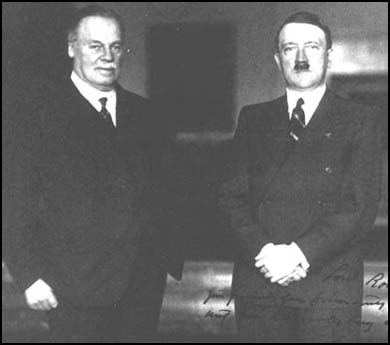
And while we shouldn't be judged on the actions of our forefathers, here is what Lord Rothermere (aka Harold Sidney Harmsworth, great-grandfather of the current Lord Rothermere, who owns Associated Newspaper - pictured with his 'hero' above) wrote in a telegram to Adolf Hitler a year before World War II broke out: "My dear Fuhrer everyone in England is profoundly moved by the bloodless solution to the Czechoslovakian problem. People not so much concerned with territorial readjustment as with dread of another war with its accompanying bloodbath. Frederick the Great was a great popular figure. I salute your Excellency’s star, which rises higher and higher. "

Rothermere also wrote an article entitled ‘Hurrah For The Blackshirts’ in January 1934. Suddenly Murdoch doesn't quite seem so bad anymore.

Pollard quits Sky News


BSkyB have announced that Nick Pollard, head of Sky News for more than 10 years, is quitting, after a multimillion pound relaunch which failed to increase viewing figures. Pollard is credited with resisting any attempts by Rupert Murdoch to make Sky News as 'partisan' as sister network Fox News in the US. Admittedly, he has been helped by regulatory laws in Britain, under which broadcast news must be impartial - although anyone who can successfully keep Murdoch at bay for a decade deserves some credit.

24 April 2006

Clarke attacks UK media

He argued it was fair that breaches of anti-social behaviour orders (Asbos) should be punishable by up to five years' jail. And he claimed the ability to impose Asbos on individuals without trial did not contravene the principle that individuals are innocent until proven guilty.

(Source: BBC)

Charles Clarke today accused the UK media of perpetuating "myths" that his law and order agenda is an attack on human rights and civil liberties. Aside from all the other dubious contentions Home Secretary Charles Clarke makes (including his attack on the three liberal newspapers - the Guardian, Independent and Observer - for showing "general intellectual laziness"), this would appear to contradict everything he states. I wonder if Clarke could explain how the ability to place an anti-social behavioural order on an individual, which could lead to five years' imprisonment, without trial is not "destroying the rule of law"?

England's finest newspapers raise their prices


The Daily Mail and Daily Express have both increased their cover price by 5p.

In today's page two announcement of the increase from 40p to 45p, the Mail says it had put its price up "reluctantly" and reminded readers it was the first increase in five years.

(Source: The Guardian)

Whether this will put readers of The Daily Hate, er, Mail off purchasing England's most patriotic of newspapers only time will tell. Rumours that it is an attempt to price immigrants out of purchasing the "thick, grey tombstone of a tabloid" are strongly denied.

Give Murdoch some credit

Pan-stick palaver

The make-up people at Sky have had, er, a makeover to help them cope with the particular challenges of high definition TV. Traditional make-up, you see, isn't enough to cover the spots and blemishes for presenters on HDTV. So thick is the new stuff that it has to be applied with an extravagant device nicknamed the "blow-job gun" by Sky insiders. Delightful.

(Source: Media Guardian)

While the intention here is to poke fun at the people at Sky News with Monkey's (see the Guardian site) inside 'scope', I think the people at Sky have done a very clever job of conveying the improved quality of picture with HDTV. This is something they failed to demonstrate (for obvious reasons) in the adverts on regular television screens but appear to be more successful at with this 'leak' - which I wouldn't be surprised to see in The Sun or The Times (for similarly obvious reasons).

20 April 2006

Welcome back to the free-world Buzz

I wonder if "Buzz" Patterson could explain exactly how Seymour Hersh has potentially placed the lives of US pilots in danger? He hasn't revealed any military secrets or uncovered any hidden government plans. Hersh was merely speculating about what he believes the US government plan to do next and stating his opinion.

Patterson clearly longs to return to the immediate aftermath of September 11 2001, when the American media was terrified of being labelled unpatriotic if it dared question its wise and noble leader George W. Bush. The former Air Force pilot implies that anyone who questions any of President Bush’s military decisions is endangering US troops and abetting the ‘enemy’. Clearly it would seem illogical to Patterson that the man who continues to set tens of thousands of men and women onto the war-path is the one who is risking American lives. Patterson was no doubt taught to never question and always obey those in power and it must be hard for him to ‘return’ to live in a society where people are allowed to form opinions of their own.

I think George W. Bush sums it up best with his now immortal line: "Our enemies are innovative and resourceful, and so are we. They never stop thinking about new ways to harm our country and our people, and neither do we."

Global crackdowns on democracy continue

Today brings news of continued silencing of the free media in Morocco, brutal crackdowns on demonstrations in Nepal, plans to increase fines for Iranians with satellite dishes (which allow them to receive foreign news) from £60 to more than £3,000 and also to jail women who are deemed to flout the regime's definition of Islamic morals, and, finally, news from China that Yahoo! helped convict a pro-democracy campaigner.

In the case of Iran it is important to remember that 65% of the population are under 25 and, as a result, are probably not irreversibly anti-West. However, if George W. Bush continues to make such inflammatory statements ("We are ready to consider all options, including military operations in order to prevent Iran from building a nuclear weapon," Bush said yesterday. "All means are acceptable in order to prevent the danger represented by Iran.") then Timothy Garton Ash's terrifying, but utterly plausible, vision (which I would urge everyone to read) could become a reality.

Bloggers beware

A tale of caution for any blogger that posts scandalous rumours or lies on the internet in the belief that it does no harm, and for any newspapers or TV station that report information found on the internet as the truth without a thorough fact check:

It later transpired he (Ilyas Kuncak, 47, a grandfather who ploughed his bomb-laden truck into the front of an 18-storey HSBC building) was driven to murder by Turkish press reports about American soldiers raping 4,000 Iraqi women. The reports, entirely erroneous, had been based upon a misreading of a blog posted by a Californian "sex therapist".

(Source: The Guardian)

19 April 2006

Bloggers aren't breaking news stories just yet

MAINSTREAM media is increasingly monitoring blogs for story leads, according to a journalist-turned-blogger at a forum on free expression and cyberspace in Manila.

With a common goal to expose the truth, the mainstream media have now embracing blogging as means to engage readers in a "conversation," said Rebecca Mackinnon, co-founder of Global Voices, an aggregator of blogs around the world.

(Source: INQ7)


While it would be nice to see a situation in which bloggers are the one's breaking the news, in the vast majority of cases they are simply adding their two cents. Most bloggers lack the money and the resources to lead with new (newsworthy) stories and most are content to comment on what is reported by the mainstream media. That is not to say that it is not possible for a blogger to bring a story to the attention of the press. At a local level, where some newspapers may lack the resources required to send a journalist to cover a local council meeting or another seemingly unimportant event, a blogger may find he or she has an exclusive story on his or her hands. In this case, newspapers and TV stations may turn to the blog to discover what transpired. In the majority of cases though, it will be the mainstream press that breaks the news. However, it is important that media organisations still turn to blogs to see what news matters to its readers and how they react to it. Newspapers or TV stations that may have under-reported or ignored a particular news item may find that it is important to many people and be required or persuaded to report it as a result. The conversation must remain the two-way process that it is slowly becoming and the mainstream media outlets that ignore the voices of their readers, viewers and listeners do so at their own peril.

18 April 2006

Kent State bans athletes from Facebook

Kent State University athletic department has joined Loyola University Chicago in banning its student-athletes from using the website Facebook. Kent State athletic director Laing Kennedy claimed that the move was purely intended to keep students safe from "weirdoes".

"In this day and age, there's enough weirdoes out there that we thought we should take a good hard look at it," Kennedy told WKYC.

Kennedy told the Daily Kent Stater that the athletic department's "interest is to protect our students".

"What really got our attention was that we had one student athlete that was contacted inappropriately," Kennedy told the university newspaper. "In checking that out, we discovered that there was personal information by a number of our student athletes on Facebook."

However, anyone accessing the university website can bring up the same information on students, including their home address and permanent phone number. While this information can be removed should a student wish, many probably remain unaware of just how much personal information is available at www.kent.edu. In contrast any information on Facebook is placed there by the user themselves and can be quickly removed. Additionally, unlike the university site, which is open to literally anyone with internet access, Facebook users must log in and can only view details of those who attend the same university or who are their 'friends'. Should we therefore presume that the university is only interested in the welfare of student-athletes?

If this was merely an issue of protecting the interests of the student-athletes the university would be better off educating them about potential dangers, which is exactly what the University of Colorado decided to do (even in light of offensive tackler Clint O'Neal and his girlfriend, cross country runner Jackie Zeigle, being accused of sending a racially threatening Facebook message to Hispanic cross country runner Greg Castro in December 2005).

"We're not going to get into the censorship business," sports information director David Plati told the USA Today in response to the potentially damaging situation. "We're just giving them smart advice."

Kennedy would be better advised to be honest and admit he is protecting his, and his department's, own interests. This is a case of an athletic department censoring its students and removing their First Amendment rights to prevent any potentially bad publicity that may be generated through Facebook. Instead they may just find that future athletes think twice before electing to compete at a school with such seemingly totalitarian policies.

Although in no way comparable, it seems rather ironical that this has taken place at a university which has a history of impinging on the rights of its students.

WKYC article
Daily Kent Stater article
USA Today article

Bloggers increasingly exerting disproportionate influence over society

According to a report by technology research company Jupiter Research, bloggers and internet pundits are exerting a “disproportionately large influence” on businesses and opinion. The study suggests that although ‘active’ web users make up only a small proportion of Europe’s online population, they are increasingly dominating public conversations and creating business trends. Companies like McDonald's and computer firm Dell have both fallen foul of internet buzz in recent years.

“It’s always been the case that vocal minorities are listened to by media organisations, brands, advertisers and marketers - normally because they’re thought to represent a wider swath of opinion,” said Tom Coates, a technologist with Yahoo! and prominent blogger. “TV and radio programmes are censored or pulled on the green-inked letters of a few hundred people, products removed from shelves because of less than 100 complaints. On that basis, these figures start to sound like a pretty large number of people, and probably a much more representative sample than perhaps before.”

(Source: The Guardian)

While it has always been the case that a relatively small number of people exert a disproportionately large influence on society, the advent of blogs and the Internet has given anyone with access to the net the opportunity to be part of that select group. Whereas in the past money and one's position in society determined whether the individual even had a chance to really influence anyone outside of one's immediate group, the creation of the worldwide web has led to an army of potential 'leaders'.

Russians protest against media clampdown by state

A thousand people protested in Moscow on Sunday against the government’s clampdown on independent media, five years after the Kremlin effectively took control of private channel NTV. The protestors, who included well-known television reporters who have lost their jobs, brandished placards reading “Today censorship, tomorrow dictatorship” and “Down with Kremlin-TV”.

The Daily Times reports on the backlash against the government clampdown on independent media in Russia. While this signals a dangerous intent to return to the communist days of total state control, at least it appears as though the Putin-led government is allowing some form of protest to take place. Perhaps the same thing should be happening in Italy now too.

14 April 2006

China battles free-flow of information

China's government has told local TV stations not to use video from foreign sources to produce news bulletins. New rules ban the use of footage acquired from foreign satellite TV and other channels that are not state-run. Stations have been told they should only use news reports provided by the state-run China Central Television and China Radio International.

(Source: BBC)

Following the reports of crackdowns on the media in Iran and Belarus, comes the news that the Chinese government has banned local broadcasters from using foreign sources. The Chinese State Administration of Radio, Film and Television has reportedly called on the media to show greater "political and propaganda discipline".

Reporters Without Borders have called on members of the World Trade Organization to oppose the media restrictions just adopted in China. President Hu Jintao is visiting the US later this month and the group hopes that President George Bush will raise the issue with his counterpart.

"This reinforcement of protectionism by China is clearly aimed at increasing control of media content and is a new violation of press freedom," Reporters Without Borders said in a statement.

After Google's submission to the Chinese authorities, this news appears to be another step back in China's international relations. The government in China knows that the internet and the media represent the biggest threat to their power and are doing everything they can to prevent a free-flow of information. Informed citizens are the biggest danger to an autocratic government and the officials in charge of China will fight any knowledge that seeps through with all the propaganda they have at their disposal.

Bloomberg misleads public over Iran's nuclear capabilities

Bloomberg yesterday ran the headline 'Iran Could Produce Nuclear Bomb in 16 Days, US Says' with the following reported underneath:

Iran, defying United Nations Security Council demands to halt its nuclear program, may be capable of making a nuclear bomb within 16 days, a U.S. State Department official said.

Iran will move to "industrial scale'' uranium enrichment involving 54,000 centrifuges at its Natanz plant, the Associated Press quoted deputy nuclear chief Mohammad Saeedi as telling state-run television today.

"Using those 50,000 centrifuges they could produce enough highly enriched uranium for a nuclear weapon in 16 days,'' Stephen Rademaker, U.S. Assistant Secretary of State for International Security and Nonproliferation, told reporters today in Moscow.

However, later in the report Raedmaker reports that the Iranians currently only have 164 centrifuges in operation today and his '16 days' response was to how soon Iran could produce a nuclear weapon once it reached the "industrial scale" capacity. Seven paragraphs into the article, Raedmaker predicts that it would take at least 13 years for them to reach this stage. So why did Bloomberg choose to use such a misleading headline and spend the majority of the article pressing home this sensational statement? While this is something we have come to expect of British tabloids, it is disappointing to see an organisation that calls itself the "leading global provider of data, news and analytics" following the same path.

13 April 2006

Iran brutally cracks down on media

"Freedom of press and speech is not absolute and subject to the rules of Sharia and the law," General and Revolutionary Prosecutor, Saied Mortazavi, who was reportedly involved in the murder of Zahra Kazemi, the Iranian-Canadian photojournalist, told a group of reporters who cover the regime's Majlis (Parliament) yesterday.

(Source: The National Council of Resistance of Iran)

Whilst Mortazavi's comments are hardly likely to shock anyone around the world they do highlight the desperate situation in that country right now. Two journalists have been found dead and another severely beaten in recent weeks as part of a crackdown on reporters and press in Iran under the rule of the mullahs. While the imprisonment of journalists and closure of newspapers has been commonplace in Iran in recent years, events have taken a sinister turn for the worse. In April 2001, the National Union of Journalists called on trade-unionists - both in the press and other unions - to " isolate those who are hoping to silence the Iranian people into submission" by boycotting the Islamic Republic of Iran Broadcasting network. In addition, it is important that these cases receive coverage in the mainstream media, alongside the current nuclear weapons' story, and that Iranians who are able to get online can find out what might otherwise be censored.

12 April 2006

Berlusconi must give up power


Despite Silvio Berlusconi's narrow loss in the recent Italian election it will be extremely difficult for Romano Prodi to shift Italy's richest man from power. Berlusconi, directly or indirectly, currently holds sway over 90% of the country's broadcast media. With a reported one million spoilt ballots, a lead of just 25,000 and the Italian broadcast media against him, Prodi faces an uphill battle to shift the man who declares himself to be the "Jesus Christ of politics". If he secures his rightful place as prime minister of Italy, Prodi must immediately push for a new conflict-of-interest law that will force Berlusconi to relinquish ownership of his family holding group Fininvest SpA or leave politics. It is a disgrace that a democratic nation ever allowed the situation to develop whereby the head of state controlled such an overwhelming majority of the broadcast media and, should he emerge victorious, Prodi must rectify this as quickly as possible.

Rumsfeld turns on racist American media


US Secretary of Defence Donald Rumsfeld has rightly criticised the American press over its handling of the sale of national ports to a company owned by the United Arab Emirates.

"The UAE has been a staunch supporter in the war on terror and you people were on their backs like they were a bunch of criminals," Rumsfeld said to a gathering of the nation's press yesterday. "Norway hasn't sent a troupe to Iraq but they get to do anything they want. Look here on page D-27 of the San Francisco Chronicle. There's a fascinating little pictorial on this hairy little Norwegian fellow who goes by the name Hagar the Horrible, who's apparently launching an invasion against some unnamed country. Where's that Viking ship going? I'd sure like to know, wouldn't you? Talk about threats to national security. Yet, because the Norwegians are fancy Europeans, all we get from the media is three panels of lousy pen-and-ink drawings. Is this serious journalism?"

DP World was immediately condemned as a group of terrorists just because they are based in the Middle East. This was despite the fact the UAE was one of America's allies and the US would still control all port security. The American media was quick to jump on the bandwagon and join the xenophobic banter that did little for the credibility of many newspapers and broadcast stations. While the US expects to Americanise the rest of the world through incessant expansion and take-overs of foreign companies, heaven help any group from outside America who dares come to their shores with similar ideas.

The media's reaction may be expected of small-minded individuals unaware of the facts but for the press to join in the ranting and raving was incredibly disappointing. The US is lucky their allies in the UAE did not react with more anger and DP World can at least withdraw from the US with their dignity in tact - something which cannot be said of much of the American media.

Premiership wages leap 65% since 2000

According to a study conducted by the Independent and the Professional Footballers' Association, the salaries of players in the Premiership have risen by 65% since 2000. The average player in the English top flight now earns £676,000 in basic pay, in comparison to £410,000 just six years ago. (Source: The Irish Times)

There is one person behind this astronomical wage rise: Roman Abramovich. The Russian billionaire's financial clout has led to an inflated transfer market in which clubs and players are demanding obscene fees safe in the knowledge that at least Chelsea can, and are probably prepared, to pay them. A salary cap may be the only way to keep the Premiership competitive.

Only £600,000 to go then ...

The Sun and News of the World today agreed to pay £100,000 in damages to Wayne Rooney over allegations that he assaulted his fiancee in a nightclub.

(Source: The Guardian)

Immigrants are invading America, claims Hollywood director

"The result is the south-west (of USA) will fall away. At some point, ethnically, demographically, those people will say, 'This belongs to Mexico. We're the northern province of Mexico. They're already saying it'... I think that 20, 30 years from now, we will be looking back at this period. This will be the watershed. And we have to decide now, this , I don't, this is not immigration. This is an invasion. This is a future annexation, a satellite state north of the Rio Grande. "

Ron Maxwell, director of the movie Gods and Generals, speaking on Fox News on 10 April 2006 (Courtesy of Media Matters).

In case you thought Mexicans were crossing the border into the US to find better job opportunities and an improved way of life, Ron Maxwell will set you straight. According to Maxwell, the reason those pesky immigrants are crossing the border is an attempt to turn the south-west part of America into Mexico and, presumably, return to the poverty they led us to believe they were escaping. No doubt this all makes perfect sense to regular Fox News viewers.